“Crucified with Christ, I Live” (1)

“Crucified with Christ, I Live” (1)

But did Paul’s relationship to the law change? Did the law change? Did the law change its demands? Did the law say to Paul, “Do your best, and I will cut you some slack”? Did the law say to Paul, “Do not worry—God grades on a curve”? Did the law say to Paul, “You are better than others and God appreciates your sincere efforts to keep me”? No, the law does not change and it cannot change. The law is the unchanging standard of God’s righteousness. There is nothing wrong with the law, but there was everything wrong with Paul; there is everything wrong with us.

Did the law die, then? Was the law abolished or abrogated? Did God say, “I see that you cannot keep my commandments; therefore, I will no longer require it”? Did God cancel his requirements and then accept something less than perfect obedience instead? The answer is no! The law is still in force and all sinners who are under the law must perish, therefore.

The answer is that Paul changed. The law did not die, but Paul died. “I am dead to the law” or “I died to the law” (v. 19). Paul’s relationship to the law changed because he died; when Paul died, the law lost its power over Paul. The law, says Paul, cannot condemn me; it cannot curse me; it cannot damn me; and it cannot hold me captive.

The Creeds, Assurance, and Good Works (3): Canons 1:16 (b)

The Creeds, Assurance, and Good Works (3): Canons 1:16 (b)

We would break the bruised reed: we would trample it underfoot as something worthless; yet, our merciful God has promised never to do that. Instead, gently, kindly, in great compassion he preserves the bruised reed, and even heals it by the power of his grace. We would quench the smoking flax: we would snuff it out as something that irritates more than illumines; yet, our merciful God has promised never to do that. Instead, he gently blows on the dying embers so that we shine more brightly to his glory.
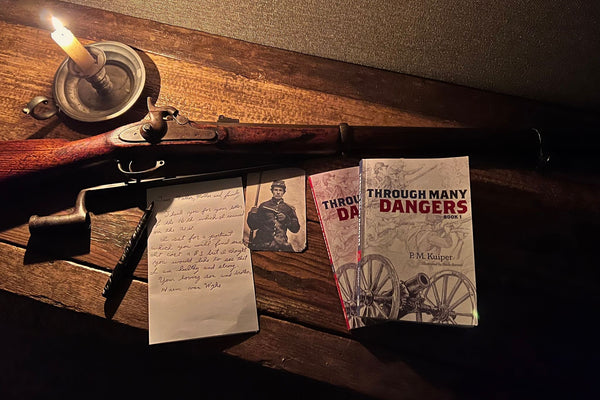
"Hard to put the book down" – A review of 'Through Many Dangers'

"Hard to put the book down" – A review of 'Through Many Dangers'

A review by Annemarieke Ryskamp of Through Many Dangers, as it appeared in The Outlook, Vol. 71, Issue 6. Photo...

The Creeds, Assurance, and Good Works (3): Canons 1:16 (a)

The Creeds, Assurance, and Good Works (3): Canons 1:16 (a)

One who has imperfect faith, one who sorrows over and flees from sin, one who has a small beginning of the new obedience, such a person must not view himself as reprobate. Why not? Because his holy longings after Christ, his holy hatred for sin, and his holy desires to obey God, as languid as they may be, are sure indications that God is at work in him by his grace. Let him continue to use the means of grace. Let him lay aside “all filthiness and superfluity of naughtiness” and let him “receive the engrafted word which is able to save [his soul” (James 1:21). Let him, as a newborn babe, “desire the sincere milk of the word that [he] may grow thereby” (1 Peter 2:2). Let him not say, “Woe is me, for God has rejected me!”
"Chief characteristic of the pilgrim is hope"

"Chief characteristic of the pilgrim is hope"

The chief characteristic of the pilgrim is hope. His heart is set not on the things of this earth, but upon his heavenly and eternal inheritance. Hope pulls the Christian pilgrim toward the future with a certain implied dissatisfaction with life as it is, and with an impatience for the journey to be over. So much is hope dominant in the epistle that Peter has rightly been called “the apostle of hope.”
Samson Forfeits his Office (2): A Foolish Game

Samson Forfeits his Office (2): A Foolish Game

Samson’s game has a fatal flaw built into it: it does not take into account the enslaving power of sin or the holiness of God. If we sin once, we sin again; sin becomes a habit, a pattern. The sinner tells himself that he can stop whenever he wants, that he will not go too far in sin, and that sin has no effect upon him. He tells himself that he can stop sinning when he feels that the time is right to retreat. But sin is deceitful: it draws us into its web until we are hopelessly trapped. That was Samson’s experience: first, he married a Philistine; then he slept with a harlot; and now, he is in the bedroom of Delilah playing a dangerous game. With every question he gets closer to losing. 

We must flee from Samson’s game. We do not ask, “How many sins can I get away with?” but “How can I best glorify God?” We want to be as far away from sin as possible, not as close to sin as we dare.