
Your cart is empty now.

Caesarea Maritima: A Harbor for God’s Purpose
The following article is part of the "Biblical Obscurities" blog series by Mike Velthouse, author of Journey Through the Psalms. For years, Mike has been writing articles for his church's monthly newsletter on a number of "obscurities" within the Bible. We will be reprinting many of those articles in the next few months here on the RFPA blog. Join our email list here to receive a notification in your inbox for new additions to this blog series! Image credit: https://www.
Imagine yourself as a young adult living in the large port city of Alexandria, Egypt. It’s the year 10 BC. You’ve lived by the great Mediterranean Sea your whole life. You love everything about the sea: the color of the water, the rise and fall of the waves, the clouds above that seem to have the ability to create their own bodies, and even the way a storm develops miles away and then ominously turns right toward you. But mainly, you love the ships – the shapes, the sizes, the flags they fly, the way they maneuver into the port as though they have a mind of their own.
You are drawn to work on one of those ships someday. You never stop thinking about that. You finally find a job washing boats as they rest in their port slips. Then, you begin unloading cargo from smaller ships. You advance into loading freight into larger vessels. You learn the ways of marine transportation by watching the experts. Then, the day you’ve been dreaming about arrives: you are promoted to deckhand on a large vessel shipping wheat to Rome.
When the day of departure arrives, you are delighted to discover your first stop will be at a brand-new harbor up the coast of Israel called Caesarea. You've heard stories about how this is a port unlike any other. Created by a ruler named Herod, this ten-year construction project turned a small, dilapidated pier called Stratos Tower into a majestic harbor and city called Caesarea Maritima ("Caesarea by the Sea"): a must-see for all in the shipping world. And now you are only 250 miles away from seeing Caesarea for yourself.
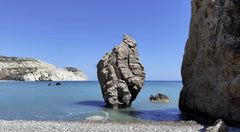
As your ship approaches Caesarea, your heart thumps with excitement, seemingly a bit faster with every ebb and flow of the waves. Your eyes widen as you see the size of the harbor. Its south break wall extends 600 feet into the sea. The north break wall, where your ship enters, measures 300 feet. The port itself is capable of holding 300 vessels. You’ve heard that this is one of the era's most remarkable engineering feats. Herod’s engineers had installed breakwater wall foundations using planks filled with hydraulic cement that hardened in the water. On top of these planks, rocks were assembled to make the break walls. Since Herod would never consider anything built in his honor to be "over the top," the entire 600-foot south wall houses his magnificent palace. Inside the walls is his residence, including an Olympic-sized swimming pool carved into the rock floor, extravagant gardens and refreshing canals – and, for the governors who followed Herod (like Pilate, Felix, and Festus), the regional legal court and prison (Paul was kept here in Acts 23-26).
Once you exit your docked ship, you have the whole city of Caesarea right before you. The first building that beckons as you enter the town is a temple dedicated to Caesar Augustus. Surrounded by Corinthian columns and standing 100 feet high, this temple was built by Herod in high honor of Caesar Augustus.
Then, you hear the roar of a crowd coming from somewhere. You head south along the coast, to where a massive hippodrome stands. This long oval arena has a max capacity of 10,000 spectators, and the noise you hear coming from inside only gets more deafening as you approach.
When you enter, you discover chariot races taking place. The rumble of the horses' galloping feet and the fanatic cheers from the delirious crowd make your heart vibrate so much, you feel it may jump out of your chest. Afterward, as you exit the arena, you vow to return here someday to watch a famous Roman gladiator tournament or one of many other athletic events.
As you walk further south, you locate a spectacular open-air theatre. With semi-circular seating (made of limestone, volcanic rock, and concrete) extending far into the air, it offers a breathtaking view of the Mediterranean Sea as backdrop to the stage. This is where the people were led to believe that Herod Agrippa had spoken with "the voice of a god" after he gave a speech (Acts 12).
Even with all you've seen, there are many other things on your list to visit in Caesarea: these include a water-supplying aqueduct that begins eight miles to the north at Mount Carmel, many Roman bathhouses, and the "Cardo Maximus," the main boulevard for shopping.
This city is quite the man-made accomplishment, especially considering that the town didn’t even exist in the Old Testament. Herod built this city to celebrate humanism: the glory of Caesar Augustus, the Roman Empire, and Herod's own worldly achievements. Herod established this city to celebrate man forever and built the harbor to show he could “conquer nature” himself. Caesarea Maritima certainly boasted all the worldly pleasures man could ever hope for.
But God had other plans.
Fast forward in time to 115 A.D. Imagine yourself in Antioch, Syria, about 300 miles north of Caesarea Maritima. It all started with a rumble underground. At first, you just hear it. Then you feel it. A slight vibration beneath your feet turns into a shaking that sends you tumbling to the ground. The shaking progresses into what seems like an explosion in the depths of the earth that sends buildings around you crashing down into rubble. The result is a significant loss of lives and property in Antioch!
But the quakes alone are not the end of the story. Something else can develop after earthquakes occur in or near large bodies of water. An earthquake may cause the ocean or seafloor to rise in one area but fall in another. That's not good! As a result, surface water starts moving faster than usual. As the speed of waves increases, more water is gathered into these waves. Waves feed on waves, and they become taller and taller. This is how a tsunami begins, with waves that can measure 100 feet tall!
In God’s providence, an earthquake (believed to be about a 7.5 on the Richter Scale) near the city of Antioch in the year 115 A.D. created a tsunami in the Mediterranean Sea. This storm had a divinely appointed course to crash into Herod’s harbor in Caesarea Maritima and destroy it. The harbor at Caesarea would never contain ships again. “Behold, he breaketh down, and it cannot be built again” (Job 12:14). God will not be mocked by men who worship men and man’s accomplishments. Truly, “Thou shalt be visited of the LORD of hosts with thunder, and with earthquake, and great noise, with storm and tempest” (Isaiah 29:6).
However, this destruction was not to occur until after God used this manufactured harbor for His purpose. God directs worldly achievements to accomplish his plan of redemption – even things like harbors, ships, and sea trade.
During the apostolic age, Caesarea became the epicenter for spreading the gospel west into the Gentile world. This harbor permitted the apostles to travel across the sea and into Europe. Converted Romans who worked in Judea (like Cornelius) could return to Italy through this harbor with a faith to share.
Ultimately, God appointed the harbor at Caesarea Maritima to be a tool for about 80 years – but no more – to carry out Christ’s mandate in the Great Commission: "Go ye therefore and teach all nations, baptizing them in the name of the Father, and of the Son, and of the Holy Ghost" (Matthew 28:19).
Like what you've read? Click the image below to read more from author Mike Velthouse in the thirty-day devotional Journey Through the Psalms, available now on rfpa.org and in Christian bookstores near you!

Share:
Recent Posts




The content of the article above is the sole responsibility of the article author. This article does not necessarily reflect the opinions and beliefs of the Reformed Free Publishing staff or Association, and the article author does not speak for the RFPA.

Donate
Your contributions make it possible for us to reach Christians in more markets and more lands around the world than ever before.
Select Frequency
Enter Amount
United States Dollar | $USD