
Your cart is empty now.

Joppa
The following article is part of the "Biblical Obscurities" blog series by Mike Velthouse, author of Journey Through the Psalms. For years, Mike has been writing articles for his church's monthly newsletter on a number of "obscurities" within the Bible. We will be reprinting many of those articles in the next few months here on the RFPA blog. Join our email list here to receive a notification in your inbox for new additions to this blog series!
Israel has about 125 miles of coastline along the Mediterranean Sea. However, ancient Israel did not view this stretch of land in the same way the modern beach-goer does. For Israel, the coast did not represent a fun destination of sand, sun, and frolicking amongst the waves with friends or family. People in Bible times did not plan vacations to the Mediterranean Sea as we might to the Outer Banks of North Carolina, the Gold Coast of the Florida panhandle, or any state park along Lake Michigan.
Back then, the Mediterranean Sea meant chaos, rocky shores, and angry waves. It was a place where rumors of scary weather events came to life, and a place from which an enemy might attack. It’s no wonder that in Revelation 21, as John introduces us to the new heavens and new earth, the first example he uses to describe this magnificent future isn’t an end to the persecuting and oppressive Roman government of the day, a vanishing of sickness and disease, or even the abolishment of death. Instead, he makes this astounding statement: “And there was no more sea.”
One location along this restless and turbulent coastline has stood the test of time. Today, it’s known as one of the oldest seaports in the world, with the legend of its existence going back to the pages of Genesis. Here is a land-and-sea crossroads where nations, empires, and conquerors from all four directions came and went, leaving indelible marks in their wake.
Joppa.
The Gateway to Israel, and the center of Israel’s trade and commerce with the Mediterranean world.
To understand the history of Joppa, let's view the city through the lens of the two most significant men ever to have walked its streets. Two men who received the same command from God, but had two very different reactions. Two men used by God in the city of Joppa to accomplish two significant events in redemptive history.
Jonah arrived in Joppa around 750 B.C. He was fleeing God's command: "Go to the Gentiles!" Joppa and Nineveh were separated by 600 miles, but Jonah was hoping to put himself even farther away than that.
Jonah wasn't thinking about how Joppa may have been founded by Japheth, son of Noah, some 1,700 years prior. His thoughts were not on how many nations had conquered and controlled Joppa for the previous millennia, including Egypt, Phoenicia, Philistia, and Judah. It may not even have occurred to the prophet that this was the port used by King Solomon to bring forth the cedars of Lebanon for the construction of the temple in Israel (2 Chronicles 2:6).
Most likely, Jonah had only one thing on his mind: escape. Imagine the prophet meandering through the streets of Joppa, a town perched on top of a 120-foot hill which jutted out over the sea and harbor below. Think of him walking nervously through the hustle and bustle of the port, as sailors and merchants and dock workers move all around him. The harbor at that time would have been teeming with incoming and outgoing sea vessels, each laden with a cargo of agricultural products, spices, or lumber.
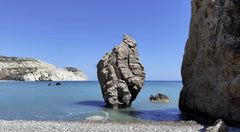
After a while, Jonah finds what he’s looking for: a large trading ship with a tall mast, square sail, and rows of oarsmen. As that ship, with Jonah aboard, departs Joppa and slowly makes its way out into the Mediterranean Sea, the prophet would have had a great view of Joppa before it faded into the distance: the city, a beacon on the hill. The sand-colored houses, the palm trees, the reef-formed breakwater protecting the harbor, and seabirds with their aerial displays above it all...Do you think Jonah wondered if he would ever return to this city?
Of course, God had other plans. A cataclysmic maelstrom, a conversion of sailors, a large fish, a prayer, three days and nights, and one vomiting later, Jonah winds up right back on the shores of Joppa. But this time, he's ready to obey God's command. He departs again from Joppa and embarks on the long trek to Nineveh, so that God can accomplish the salvation of the Assyrians in accordance with His divine will.
Although you may not remember reading about Joppa again until Acts 9, the city’s volatile and tumultuous history continues in the background of the Biblical story. The Assyrians, Babylonians, Persians, Greeks, and Romans all held control of Joppa at some point as one dominant world empire succeeded another. Historical figures like Sennacherib, Alexander the Great, Cleopatra, Mark Antony, and Caesar Augustus all played iconic roles in the drama of Joppa’s history.
When Peter arrives in Joppa around the year 34 A.D., what does he see there? He discovers a still-active harbor. He also finds an early Christian church, a group of people worshipping Jesus as the Messiah. We might even recognize a few of the members of this church. Tabitha (also known as Dorcas), full of good works, served the church by making coats and garments for the needy people of Joppa. You may remember that Peter raised her from the dead after she had passed away from an illness. Another church member, a man named Simon, worked with dead animal skins to produce leather. He provided lodging for Peter while the apostle stayed in Joppa.
It's on the roof of Simon the tanner's house where Peter can be found in Acts 10. Because of Joppa's location on a hill overlooking the Mediterranean, Peter would have had a spectacular view of the city and the sea as he sat on Simon's roof praying. It's on this roof in Joppa that God sends the vision of clean and unclean animals to Peter (Acts 10:9-16). It's here that God makes clear to Peter His plans for the Church. Once again, we hear the command from God in Joppa: "Go to the Gentiles!" But unlike Jonah's initial response, Peter obeys.
From Joppa, the apostle travels 30 miles north to Caesarea, where he brings the gospel to a Roman centurion, a Gentile named Cornelius, resulting in faith, a baptism, and the beginning of a worldwide Church for Jews and Gentiles alike. This Church, built on faith in the Lord Jesus Christ, soon spread to Cyprus, Crete, Asia Minor, northern Africa, Greece, Rome, and beyond.
So, what does the rest of Joppa's history look like? Time passes for the city's occupants much like it always has, with a potpourri of different occupiers, conquerors, and controllers taking charge. The last 2,000 years of world history have seen Joppa ruled by Romans, Arabs, Crusaders, Ottomans, and even the British. Today, you won't find Joppa on a map. But you might notice the city of "Jaffa" in its place. Joppa, now known as Jaffa, is a southern suburb of Israel's second-largest city, Tel Aviv.
Jaffa is about 40 miles west of Jerusalem, and about 40 miles north of the location of the October 7, 2023, Hamas attacks on Israel. The threats of chaos and calamity that once plagued the seaport have never really left this region. Still, Jaffa is a popular tourist destination. Today, you can tour sites such as the fishing and recreation seaport, visit the legendary house of Simon the tanner and St. Peter’s Church—and of course, take in a breathtaking view of the Mediterranean Sea from atop the Joppa city hill.
Joppa. The Gateway to Israel, a place where the sea and salvation met. A city with a volatile history, situated on a treacherous sea. Yet, a city that brings us great news. “Be it known therefore unto you, that the salvation of God is sent unto the Gentiles, and that they will hear it” (Acts 28:28). This proclamation guarantees the believer's entrance into the new heavens and new earth—where there will be no more sea.
Like what you've read? Click the image below to read more from author Mike Velthouse in the thirty-day devotional Journey Through the Psalms, available now on rfpa.org and in Christian bookstores near you!

Share:
Recent Posts





The content of the article above is the sole responsibility of the article author. This article does not necessarily reflect the opinions and beliefs of the Reformed Free Publishing staff or Association, and the article author does not speak for the RFPA.

Donate
Your contributions make it possible for us to reach Christians in more markets and more lands around the world than ever before.
Select Frequency
Enter Amount
United States Dollar | $USD