
Your cart is empty now.

The House of Annas
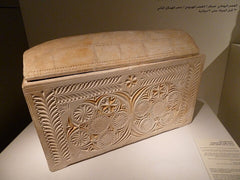
The following article is part of the "Biblical Obscurities" blog series by Mike Velthouse, author of Journey Through the Psalms. For years, Mike has been writing articles for his church's monthly newsletter on a number of "obscurities" within the Bible. We will be reprinting many of those articles here on the RFPA blog. Join our email list here to receive a notification in your inbox for new additions to this blog series! PC: Caiaphas' Ossuary, from Wikimedia Commons.
“But the chief priests and the scribes and the chief of the people sought to destroy him, and could not find what they might do.” (Luke 19:46-47)
You might recognize the following names from American history: Adams, Roosevelt, and Ford. Families of wealth and power who had generations of influence on all aspects of our culture: politics, finances, and laws. More such names, from our lifetime, include Kennedy, Bush, and Rockefeller.
One thing we know about history is that it repeats itself. These types of influential families have existed forever, and the era of New Testament Israel was no exception. However, you probably would not expect the most powerful family for the first 60 years of A.D. to be from the line of the high priest. As we will learn today, there was no family with more power, influence, and even corruption in its sphere of influence than the high priest Annas' family.
In Leviticus 8, we read of the anointing of Aaron as high priest, thus proclaiming the line of high priests to be forever from Aaron's family. That line was to continue through his son Eleazar, beginning in Numbers 4:16. By the time we reach Solomon's reign, it was Eleazar's descendant Zadok who was the first high priest in the newly built temple (973 B.C.). The line of Zadok then reigned as high priests until 175 B.C., when Antiochus Epiphanes, the Greek ruler, conquered Jerusalem. After this, the office of the high priest was defiled with men appointed by Greek and Roman rulers based on payments, briberies, or political expediencies rather than ancestry.
Annas was appointed high priest in A.D. 6 by Quirinius, the Roman governor of Syria (the Cyrenius of Luke 2:2). Over the next 50 years, seven different members of this family would rule as high priest, including five sons, one son-in-law, and one grandson. These men belonged to the sect of the Sadducees, filled high offices among the Jews, and acquired enormous amounts of wealth. Throughout this period, although Annas was not officially the high priest the entire time, he still acted like a mafia head to whose will all his family members bowed.
YEARS HIGH PRIEST PERSECUTION
6-15 Annas Death of Jesus
Trials of Peter and John
16-17 Eleazar (son)
18-36 Caiaphas (son-in-law) Death of Jesus
Trials of Peter and John
Death of Stephen
36-37 Jonathan (son) Wrote the letters of approval for Saul to carry to Damascus to persecute there (Acts 9:2)
34-41 Theophilus (son)
42-43 Matthias (son) Death of the Apostle James
61-62 Annas (son) Death of James, Jesus’ Brother
65-68 Matthias (grandson, son of Theophilus)
The family accumulated much of their wealth from what was known as "the booths of the sons of Annas." These were market stalls set up in strategic locations: some near the Mount of Olives and some inside the temple complex, such as in the Court of the Gentiles. Annas' sons had a monopoly on selling items needed by traveling pilgrims for use in the temple. Their booths sold sacrificial animals at exorbitant prices. Since those who traveled could not take their animals with them to sacrifice, they would have to purchase them once they reached town. The sons also enforced a "temple tax," used for temple upkeep and maintenance, which had to be paid with a particular coin. They would offer money exchanges to foreign visitors who needed to acquire this coin but would demand huge profits on each exchange.
In an era where most high priests only served for a year or two before being deposed by the Roman leaders for someone else who would pay more for the office, it is pretty amazing that Joseph Caiaphas was able to hold the office for 19 years (A.D. 18-36). That shows how much wealth he and the family had, and how much they were willing to pay, to remain high priest for so long.
The Talmud (written between A.D. 200-350) is an ancient collection of writings that covers the whole gamut of Jewish life and tradition. In it is recorded a popular rhyme that describes the family of Annas:
“Woe to the house of Annas!
Woe to their serpent's hiss!
They are high priests;
their sons are keepers of the treasury,
their sons-in-law are guardians of the temple,
and their servants beat people with staves." (Pesachim 57a)
During the rule of the Roman empire, there existed what is known as the "Pax Romana." As long as the conquered nation kept the peace and paid their taxes to Caesar, the local Roman ruler would let them honor their religious and cultural practices. This peace was vital to the survival of the house of Annas, as it allowed them to run Jerusalem through the Sanhedrin (of which the high priest was president) without Roman intervention. In other words, Annas and his family could continue to rule as long as this peace existed.
Once Jesus arrived and overthrew the money changers in the temple (John 2), he instantly represented a threat to the Annas family's way of life. His righteous anger was an attack on their financial means, and there could be dire consequences for the family if Jesus persisted. Thus, they viewed Jesus as a fanatic who threatened peace in Jerusalem. However, their utter hatred for Jesus was not for religious purposes, but because this man who prophesied of the temple's destruction was someone who could ruin the family's wealth, positions, and life's work.
When Annas' son-in-law Caiaphas declared, "it is expedient for us that one man should die for the people, and that the whole nation perish not" (John 11:50), he spoke to protect their house from the wrath of the Roman government. After that, the Sanhedrin “from that day forth took counsel together for to put him to death” (John 11:53). In John 12:1-2 we even read of a plot by the chief priests (led by the high priest) to kill Lazarus “because that by reason of him [his being raised from the dead] many of the Jews went away, and believed on Jesus."
We must understand that Annas and Caiaphas were not simply innocent bystanders in Jesus' death, forced to be involved in the situation only because of their offices. They were willing plotters and participants. They were not awakened out of sleep during the night of Jesus' illegal trial, quickly putting on some clothes and freshening up, so they could ask Jesus a couple of questions to make everything seem legitimate. They were lying in wait for him. This was finally the moment for which they had been waiting! In cold blood, they were responsible for murdering our Lord Jesus Christ.
Annas, ever the master and ruler behind the scenes; Caiaphas; and the next high priest son Jonathan (the John of Acts 4:6) were tireless in trying to find ways to exterminate those who believed in Christ, but the three men had a difficult time trying to make that happen. Much to their disgust, the death of Jesus did not put out the flame of Christianity. Due to the providence of God working through the apostles, belief in Jesus Christ as Messiah only grew with each passing day. Even many Pharisees were converted after the death of Christ and had much sympathy for his followers! By the time we read of Peter and John being put into prison twice (Acts 4 and 5), the persecution of Stephen (Acts 7), and the murder of the apostle James (Acts 12), the Sanhedrin was split between the Pharisees' sympathy towards the Christians and the Sadducees' hatred of Christians.
However, as wealthy and powerful and evil as these men were, we know they all were pawns in God's hands. They tried extinguishing this “rabble-rouser," Jesus of Nazareth, and his followers. However, all they succeeded in doing was carrying out God's will, for Jesus was “delivered by the determinate counsel and foreknowledge of God” (Acts 2:23). Our God is the God of all history and all of history's leaders. “The king’s heart [and the high priest’s heart] is in the hand of the LORD, as the rivers of water: he turneth it whithersoever he will” (Proverbs 21:1).
"There are many devices in a man's heart; nevertheless the counsel of the LORD, that shall stand." (Proverbs 19:21)
*In an interesting footnote, during an archeological dig south of Jerusalem in 1990, a fancy ossuary (bone box) was discovered in a 2,000-year-old tomb. On the side of the box, written in Aramaic (the language of most Jews during the New Testament era), were these words: "Yehosef bar Kayafa" (Joseph, son of Caiaphas). Inside were the bones of two infants, two teenage boys, an adult woman, and a man of about 60. This ossuary is generally considered to contain the legitimate remains of the family of the high priest Caiaphas. The ossuary is now on display in the Israel Museum in Jerusalem.
**For a more in-depth reading of this subject than can be contained in this short article, I recommend “The Hatred of the House of Annas" by Paul Gaechter.
Like what you've read? Click the image below to read more from author Mike Velthouse in the thirty-day devotional Journey Through the Psalms, available now on rfpa.org and in Christian bookstores near you!

Share:
Recent Posts








The content of the article above is the sole responsibility of the article author. This article does not necessarily reflect the opinions and beliefs of the Reformed Free Publishing staff or Association, and the article author does not speak for the RFPA.

Donate
Your contributions make it possible for us to reach Christians in more markets and more lands around the world than ever before.
Select Frequency
Enter Amount
United States Dollar | $USD