
Your cart is empty now.

Patmos: John’s Exile
The following article is part of the "Biblical Obscurities" blog series by Mike Velthouse, author of Journey Through the Psalms. For years, Mike has been writing articles for his church's monthly newsletter on a number of "obscurities" within the Bible. We will be reprinting many of those articles in the next few months here on the RFPA blog. Join our email list here to receive a notification in your inbox for new additions to this blog series! Image credit: https://www.ephesusturkey.com/ephesus-highlights/temple-of-domitian/
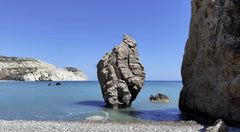
Over 1,400 islands dot the Aegean Sea, located between Greece and Turkey. Many are considered tropical paradises with powdery sand beaches and dazzling blue waters. How many of you have a location like that on your traveling bucket list? But of those 1,400 islands, one had a particular purpose in the eternal counsel of God to occupy a unique role in New Testament history. Let's look at the location of the apostle John's exile and apocalypse: “the isle that is called Patmos” (Revelation 1:9).
The year is 81 A.D. There is a new emperor on the throne in Rome, and his name is Domitian. His father Vespasian and his brother Titus were not only the two generals that led the Roman troops in the destruction of Jerusalem in 70 A.D., but they were also the two previous emperors.
Of the two brothers, Titus was the one who received the attention and love of father Vespasian. Father often scorned Domitian, sending him as the local consul to obscure regions, while at the same time, Titus received accolades, praise, and prominent positions.
After Titus died abruptly, Domitian became emperor. Suddenly he had all the power and recognition of which he had always dreamed. Yet, his reign featured astounding hatred toward anyone who dared disagree with him, with critics and opponents suffering property confiscation, exile, and even death.
While previous emperors had been declared deities upon death, that was not good enough for Domitian. He affirmed himself as "Lord and God" while living! Nero is the only other emperor to have done so, showing us the demented nature of Domitian’s mind. Because he considered himself a living deity, Domitian had temples and statues built in his honor all over the Roman Empire. Then he ordered all his subjects to worship him at these shrines.
One of these temples existed in the city of Ephesus. All that remains today are two of its thirty-five-foot columns and the foundation, but back then, this shrine measured 200 feet by 300 feet. Located on a hill on the south side of Ephesus, it could be seen all around from land or sea.

Because of the emperor’s decree, Christians in Ephesus faced a life-or-death decision: remain faithful to God or worship the emperor at his temple. Because many Christians would not bow down to the emperor, the apostle John, being the Bishop of Ephesus at this time, received the most blame. Accusing John of political defiance and subversiveness, Domitian punished him with banishment to the island of Patmos in 95 A.D.
Patmos is part of a group of Aegean islands that the Romans used to exile those considered political enemies. About 22 square miles in size, it’s a rocky, mountainous island filled with waterways. It is approximately 37 miles southwest of Miletus, the city in Asia Minor (Turkey) mentioned in Acts 20, where Paul said goodbye to the Ephesus elders.
This island was not completely desolate, even during John's exile. It boasted an active harbor, a city, a gymnasium, and a temple to the goddess Diana (Artemis). And although tradition has it that those exiled received a sentence of hard mining labor on the island, it’s likely that due to his age (he was well into his 90s), John would have been exempted from such punishment. Still, he explains his exile in Revelation 1:9 as "tribulation…for the word of God, and for the testimony of Jesus Christ."
Here on Patmos, John received the vision he wrote about in the book of Revelation. Here, John experienced being "in the spirit on the Lord's Day, and [he] heard behind [him] a great voice, as of a trumpet" (Rev. 1:10).
Domitian may have thought himself to be "God." Yet, we know that our God is the True God, in control of everything in human history, including the reigns of kings and emperors. In God's providence, in 96 A.D., court officials murdered Domitian in his bed at the age of 45, after fifteen years of power. He had become so hated by Roman citizens and the Senate alike that upon his death, they removed his name from all public structures that bore it, including the statues and temples he had built for his worship.
The Roman Senate then declared that all people banished to exile by Domitian would be freed and allowed back home. This decree released John to return to his beloved church in Ephesus, where he lived for about two more years before dying of natural causes (the only apostle to do so).
You can visit the island of Patmos today after about a seven-hour ferry ride from Greece. On the island, you can see such attractions as The Monastery of St. John the Theologian, The Cave of the Apocalypse, and The Church of St. John.
Throughout history, Domitian and other rulers may have considered themselves in control of the world, even claiming the status of gods worthy of worship. Still, "The king’s heart is in the hand of the LORD, as the rivers of water; He turneth it whithersoever he wills” (Proverbs 21:1).
Like what you've read? Click the image below to read more from author Mike Velthouse in the thirty-day devotional Journey Through the Psalms, available now on rfpa.org and in Christian bookstores near you!

Share:
Recent Posts





The content of the article above is the sole responsibility of the article author. This article does not necessarily reflect the opinions and beliefs of the Reformed Free Publishing staff or Association, and the article author does not speak for the RFPA.

Donate
Your contributions make it possible for us to reach Christians in more markets and more lands around the world than ever before.
Select Frequency
Enter Amount
United States Dollar | $USD