
Your cart is empty now.

Sergius Paulus
The following article is part of the "Biblical Obscurities" blog series by Mike Velthouse, author of Journey Through the Psalms. For years, Mike has been writing articles for his church's monthly newsletter on a number of "obscurities" within the Bible. A number of these articles have been reprinted on the RFPA blog HERE.
A lone figure stands on the pebbly shore, his face enveloped by the warm, salty winds. His toga flaps in the tropical breeze like a Roman banner waving in the wind. The symphony of the innumerable waves before him sounds like a spectacular storm. The solitary figure finally lifts his meditative gaze from the Mediterranean Sea and looks around. Pebbles and grains of sand in both directions as far as he can see. How far has each grain traveled, only to land on this very spot in Paphos, Cyprus? Perhaps they've come from Rhodes? Crete? Achaia? An interesting question, but the man's mind quickly moves on to more important things.
For Lucius Sergius Paulus, the highest-ranking Roman official on Cyprus, the last several months have been transformational and dramatic. No, those words aren't strong enough. More like life-changing with eternal consequences! It’s times like these that make one pause and reflect on one’s life journey. Reader, let's consider Sergius' life and career of service for the Roman government, society, and empire.
Sergius' reflections begin with his upbringing. Being born into the “right” family in Italy meant attending the most elite schools. Years of education filled his head with subjects such as literature, history, Greek, law, and public speaking. From the beginning, Sergius’ sights were set on the Roman Cursus Honorum, the ladder of public offices an aspiring politician must climb. A good soldier, Sergius fondly remembers that first rung of military service. Then, the climb up the ladder over the years, from one step to the next: Quaestor (finances of the state), Aedile (public works and events), Censor (property and tax assessment), Praetor (jurisprudence), and then Consul (one of two chairmen of the Senate).
And now, the last step in the ladder, the one which has brought him from Rome to this very site in Paphos, Cyprus: Proconsul. Appointed by the Senate to govern the Roman province of Cyprus for one year, Sergius Paulus has many responsibilities to perform. He administers civil affairs, presides over the courts, collects revenues for Rome, and handles any diplomatic necessities.
But something has recently changed in the disposition of Sergius’ mind and heart. His whole life has been filled with the worship of the gods of the Roman pantheon: gods like Jupiter, Juno, Minerva, and Mars. These gods, it was said, provided protection, prosperity, and wisdom. But in his short time on Cyprus, Sergius' path has crossed with that of another religious group. He has come to know the people of The Way – followers of a Jewish prophet named Jesus, a man crucified by the Roman government in Jerusalem. According to his followers, this prophet rose from the dead a couple of days later, and then ascended to heaven forty days after that. As Sergius speaks to these followers, his heart and mind begin to change. A perfect man who died to forgive the sins of those who believed in him? The Son of God who provides eternal life after death in heaven with him? I must hear more, Sergius thinks.
And then comes the day that changed the Roman official's life. Three men, preachers of The Way, arrive on Cyprus and begin making their way around the island to the capital of Paphos. Sergius must talk to them! Once word reaches him that the men have arrived in the city, he calls for them and desires to hear the Word of God. As Paul, Barnabas, and John Mark speak about Jesus, the Roman official listens intently, taking in every word. However, in the middle of their speech, one of Sergius’ now-former advisors, Elymas, interrupts the men, venomously attacking them, trying to turn Sergius Paulus from their faith. After Paul casts blindness on Elymas, Sergius’ heart turns for good.
“Then the deputy, when he saw what was done, believed, being astonished at the doctrine of the Lord” (Acts 13:12).
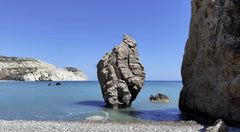
It’s that same astonishment Sergius Paulus still experiences as he stands on the shore of the Mediterranean Sea, remembering that day, and now full of faith in Jesus as his Lord and Savior. Even as he looks across the waves to Aphrodite’s Rock (a mass of rock almost one hundred feet tall and ten feet from the shore, which commemorates the supposed birthplace of the goddess of love, beauty, and pleasure), Sergius thanks God for saving him from his former idolatrous and false religion. Perhaps he even remembers Paul telling him about this proclamation from Jesus, the reason his followers are called The Way:
“I am the way, the truth, and the life: no man cometh unto the Father, but by me” (John 14:6).
What a story of grace for the first recorded Gentile convert of Paul’s missionary journeys!
Though we leave Lucius Sergius Paulus on the shore of Paphos, his story doesn’t end there. Let’s fast-forward to 1877 and enter the world of biblical archaeology, in which Bible history proves to be real history.
In the town of Soloi, situated on the north coast of Cyprus, an archaeologist discovers a Greek inscription. It reads:
“Apollonius to his father…consecrated this enclosure and monument according to his family’s wishes… Erected on the 25th of the month Demarchexusius in the thirteenth year [of the reign of Claudius – 54 AD]. He also altered the senate by means of assessors during the time of proconsul Paulus.”
According to this inscription, the monument was erected in the year 54 AD, which means it refers to an event that took place earlier than that. Everyone at the time the inscription was written would have known Paulus's identity, since modern historians generally place his time in Cyprus around 47 or 48 AD.
Ten years later, in 1887, archaeologists discover a boundary stone in Rome with this inscription:
“Paullus Fabius Persicus, Gaius Eggius Marullus, Lucius Sergius Paullus, Gaius Obellius Rufus, Lucius Scribonius Libo…The commissioners of the banks and beds of the Tiber, by the authority of Tiberius Claudius Caesar Augustus Germanicus [the emperor Claudius]…marked the boundaries [of the Tiber floodplain] by placing boundary stones on the bank.”
This informs us that either before or after his stint as proconsul of Cyprus, Sergius Paulus held an official government position in Rome, overseeing the Tiber River.
We must consider one final archaeological discovery, this from 1912. But before we do, there’s a question we need to ask. Why did Paul and Barnabas take the route they did once they left Cyprus? Why did they go to Perga, Pamphylia, and then Antioch Pisidia?
To help answer this question, we look to two inscriptions discovered in 1912 by archaeologists in Antioch Pisidia. One reads:
“To Lucius Sergius Paullus, the younger, son of Lucius, one of the commissioners in charge of the Roman streets, tribune of the soldiers of the sixth legion...”
Historians and archaeologists believe this person to be the son of the proconsul of the island of Cyprus. Another inscription found in Antioch Pisidia refers to a woman named Sergia Paula, believed to be the daughter of the same proconsul. It’s likely no coincidence that Paul and Barnabas traveled to Antioch Pisidia at the request of Sergius Paulus, so they could preach the gospel to family he had in that city.
Now, why do these historical discoveries matter? Because they provide us with earthly evidence of the reliability of the Bible’s historical narratives. Doesn’t it make us thankful that God used an author like Luke, a master historian, whose impeccable accuracy is proven time and time again in the book of Acts?
We also thank God for Lucius Sergius Paulus: an unlikely convert, but one who was, by God's providence, determined to be the proconsul of Cyprus at the exact moment in history when Paul, Barnabas, and John Mark arrived on the island with the gospel of Jesus Christ. Sergius' conversion showed the missionaries that God had indeed opened the door for Gentiles to receive salvation through the preaching of the word, giving the three men confidence to continue in their mission.
And this, of course, is the same door God has opened for us and our families. Life-changing with eternal consequences!
Like what you've read? Click the image below to read more from author Mike Velthouse in the thirty-day devotional Journey Through the Psalms, available now on rfpa.org and in Christian bookstores near you! To be notified of new Obscurities, make sure to join our email list here and be the first to hear about new blog posts and book releases!

Share:
Recent Posts



The content of the article above is the sole responsibility of the article author. This article does not necessarily reflect the opinions and beliefs of the Reformed Free Publishing staff or Association, and the article author does not speak for the RFPA.

Donate
Your contributions make it possible for us to reach Christians in more markets and more lands around the world than ever before.
Select Frequency
Enter Amount
United States Dollar | $USD