The Antithesis in Paradise

The Antithesis in Paradise

Scripture teaches no dualism, but an antithesis. There are no two primal causes and eternal principles, constantly warring with each other, but God is one. He alone is eternal and the primal cause and there is no other eternal principle or primal cause next to him. Neither is he both good and evil, nor are the principles of good and evil to be traced to his being, for he is a light and there is no darkness in him. But this good and glorious God according to his eternal and sovereign good pleasure wills to reveal his praises, his eternally adorable virtue antithetically, that is, in opposition to darkness. Darkness, evil, sin are not primal principles, eternally coordinate with light, goodness, righteousness, but the former are subservient to the latter, darkness must serve to bring out the glory of the light, the devil serves to enhance the unsearchable riches of God's being and virtues and works.

In the light of this idea of an antithesis we can under­stand the placing of “the tree of the knowledge of good and evil” in paradise. By means of it, God carries the antithesis into the life and before the consciousness of man, made after his image.

Jehovah’s Goodness

The Lord is good to all…but all the wicked will he destroy. Ps. 145:9a, 20b

Emphatically, according to the Hebrew original, the poet, who is the inspired author of this psalm, puts it: “Good is Jehovah.”

The Lord is goodness essentially.

Apart from any relation to his creatures, conceived all by himself, in himself, for himself, as the absolutely self-existent, self-sufficient, independent one, the Lord is good. His essence is goodness, his eternally adorable divine being is only good. Could we enter into the amazing profundity and explore the fathomless depths of his infinite being, the deepest depths of the incompre­hensible divine essence would reveal nothing but good­ness.

He is the light and there is no darkness in him. He is truth, righteousness, holiness, purity, love, grace, mercy and eternal life, and there is no lie, unrighteous­ness, defilement, corruption and death in him.

Christmas Joy

Christmas Joy

And the angel said unto them, Fear not: for, behold, I bring you good tidings of great joy, which shall be to all people.—Luke 2:10

Fear not!

Tidings of great joy, indeed, I bring!

Was it Gabriel, the angel that standeth before God, who so suddenly burst forth in the darkness of the night from heaven’s star-studded canopy, and appeared upon the peaceful scene of the shepherds keeping watch over their flock?

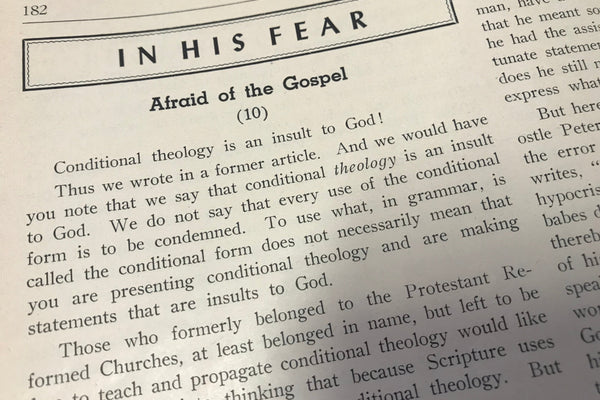
Afraid of the Gospel (10)

Afraid of the Gospel (10)

Conditional theology is an insult to God!

Thus we wrote in a former article. And we would have you note that we say that conditional theology is an insult to God. We do not say that every use of the conditional form is to be condemned. To use what, in grammar, is called the conditional form does not necessarily mean that you are presenting conditional theology and are making statements that are insults to God.

Our classic advent devotional

Our classic advent devotional

What child of God, saved by grace, does not turn with an ever new interest and spiritual delight to Bethlehem in “the fullness of time,” to contemplate in humble adoration the mystery of salvation, revealed, yet hid, in the child in the manger? ... Millions of sermons have been delivered on this theme…but the theme was never exhausted and always kindles anew the interest of the believer.—Herman Hoeksema

December 15, 2019 Standard Bearer preview article

Protestant Reformed Missions: The War Years

Mission Work Flounders (1940-1946): 5

There are various legitimate means evangelism committees and mission committees use to spread the gospel. One such means already faithfully used by the PRC Mission Committee was that of the printed page. During the years that war was being waged in Europe and the south Pacific, various churches, especially First PRC in Grand Rapids, published pamphlets addressing diverse doctrinal and practical issues—many of them written by Rev. Herman Hoeksema.